LESS AWKWARD. MORE CONNECTED.

10 free youth group
icebreaker games.

One less thing to plan for tonight.

For teens who are meeting for the first time—or just need a little help getting started. Pick a game, grab the instructions, and make tonight easier.

All 10 games are free. No account needed to read or copy.

Illustration of teens laughing together during a group game
The best start to the night“Wait, you like that too?”
10 complete games · Ready to leadReal constraints · Group size, time & suppliesYour choice · Read, copy & adapt

LET’S GET YOUR GROUP TALKING

Find tonight’s icebreaker.

Planner-generated ideas, edited for clarity, timing, and participation, plus a leader-selected Skit in a Bag activity. Each example shows a specific sample group of teens ages 13–17. These are starting scenarios, not attendance limits; many games scale through pairs or small teams.

10 games to choose from

Common Ground

Find someone who likes what you like · 8 min

Any group size
Pairs

The group this fits24 teens, ages 13–17, with several newcomers. An indoor opener with no equipment.

How to play

  1. Offer a concrete prompt: find someone who enjoys pizza, drawing, rainy afternoons, or hiking. Students can suggest another choice if none fits.
  2. Let pairs chat for one minute about their shared interest. Seated students can raise a hand and talk to someone nearby.
  3. Try four prompts, changing partners when comfortable. Anyone may pass.
  4. Invite volunteers to share one connection they discovered.

Preference Spotlight

Can your volunteers read the room? · 8–10 min

Any group size
3–4 volunteers up front

The group this fits30 teens, four willing volunteers, and a seated audience. A lighthearted upfront game.

How to play

  1. Prepare four cards: sweet or salty, beach or mountains, movie or game night, chocolate or vanilla.
  2. Invite volunteers to stand or sit up front. Show them a choice and ask them to predict what the room prefers.
  3. Have them quietly tell the leader their prediction. Read the choices aloud and ask the audience to hold up one or two fingers.
  4. Reveal the prediction and compare it with the room. Invite one student to explain their choice.
  5. Repeat with the other cards, offering new volunteers a turn.

Shared Favorite Activity Pairs

Learn a name and a conversation starter · 8–10 min

Any group size
Pairs

The group this fits12 teens, including newcomers, seated in pairs. A calm start without asking for private memories.

How to play

  1. Invite each partner to share their name and a hobby or favorite activity. Allow one minute each.
  2. Ask one friendly follow-up, such as what they enjoy about the activity.
  3. Partners agree on one detail they are happy to have shared.
  4. Combine two pairs. Each student introduces their partner in one sentence to those three people. Keep introductions in these small groups so everyone gets a turn, however large the room.

Story Tag

Build a wonderfully silly story together · 8 min

10–16 students
Seated circle

The group this fits16 teens in a seated circle on a rainy evening. A creative opener without personal disclosure.

How to play

  1. Start a fictional story: 'A penguin arrived at youth group carrying a pizza.'
  2. Move around the circle, inviting each person to add one short sentence. Anyone can pass.
  3. Keep the story kind and fictional. Offer 'What happens next?' if someone wants help.
  4. After one round, invite a volunteer to end the story. Start a second short story if time remains.

Two Truths and a Lie

Guess the made-up favorite · 8–10 min

Any group size
Groups of 3

The group this fits12 teens in small seated groups. Light preferences replace embarrassing facts or secrets.

How to play

  1. Model three preferences, two true and one invented: 'I like popcorn, I prefer rainy days, and I love broccoli.'
  2. Give students a minute to prepare three statements. They may use a familiar fictional character instead, or pass.
  3. In groups of three, each willing student shares their statements. Others guess the made-up preference.
  4. Reveal the answer and allow one friendly follow-up. Rotate until everyone who wants a turn has had one.

Rapid-Fire Favorites

Show your choice and spot a match · 5–8 min

Any group size
Whole group, seated

The group this fits18 teens in an indoor room. A quick opener without moving furniture or gathering supplies.

How to play

  1. Explain that one, two, or three fingers represent each answer. Students may also point or pass.
  2. Read 'Popcorn, pretzels, or fruit?' and name each numbered option.
  3. Let students show their choice, then share a short reason with a neighbor.
  4. Repeat with four to six choices: reading, drawing, or music; beach, forest, or mountains; board games, puzzles, or movies.

Partner Venn Diagram

Different interests. Something in common. · 8–10 min

12–20 students
Seated pairs

The group this fits16 teens at tables. A visual conversation starter for students who enjoy drawing or writing.

How to play

  1. Give each pair paper and a pen. Draw two overlapping circles, one for each partner.
  2. Spend four minutes adding hobbies or favorites: one person's interests on the left, the other's on the right, and shared interests in the overlap.
  3. Aim for two shared interests. Students can write, draw, or ask a leader to help record ideas.
  4. Invite each pair to share one agreed connection with another pair or the room. Let students keep their page.

Skit in a Bag

A few random props. A gloriously unexpected scene. · 8–10 min

Any group size
4–6 volunteers up front

The group this fits60 teens in the audience and four to six drama-loving volunteers up front. A playful performance for students who want to act, while everyone else enjoys watching.

How to play

  1. Before starting, invite four to six willing volunteers and explain the activity. Everyone else stays in the audience; no one has to perform.
  2. Divide the volunteers into two small casts. Give each cast a bag with three safe everyday props, such as a hat, wooden spoon, and scarf.
  3. Give them two minutes to prepare a 60-second scene that uses all three props in unexpected ways. Offer a setting: a restaurant on the moon, a superhero job interview, or an unusual lost-and-found.
  4. While they prepare, invite the audience to suggest a harmless name for an imaginary character. The leader can share it with both casts as an optional bonus.
  5. Each cast performs its scene up front. Introduce the volunteers by name and celebrate both performances with applause. If time allows, willing volunteers can try a second setting.

Preference Spectrum

Find your place between two easy choices · 8 min

Any group size
Whole group

The group this fits15 teens in a room with a clear walkway. Optional gentle movement with a seated choice every round.

How to play

  1. Explain an imaginary line: one end means sunny weather, the other rainy weather. Anywhere between is welcome.
  2. Students choose a spot, point, or hold up one to five fingers from their seat. Passing is fine.
  3. Invite neighbors to discuss their choice for 30 seconds. Ask for one or two volunteer answers.
  4. Repeat with sweet or salty snacks, beach or mountains, and warm or cool weather.

These are sample scenarios, not customer stories. Participation is always optional; offer a seated version and a chance to pass. Check your room and supplies before playing.

THE LIST GETS YOU STARTED. THE PLANNER GOES FURTHER.

A game that fits.
A plan you can lead.

You tell it about your students and this week’s needs. Youth Ministry Planner uses your group size, space, available supplies, time, and ministry preferences to generate the pieces of your youth night together—so you spend less time assembling a plan and more time shepherding students.

  1. Give it your ministry’s context.Set up your group’s ages, size, facilities, and teaching preferences. Add this week’s Scripture, schedule, supplies, and special requests.
  2. Let the Planner do the first-draft work.It generates teaching material, games, discussion questions, a meeting outline, supply lists, and supporting content for the parts you include.
  3. Review the plan. Get back to your people.Edit any section or ask for a change. You bring the pastoral judgment; the Planner gets you started with a plan in place.
Start my free trial

14 days free · No credit card required
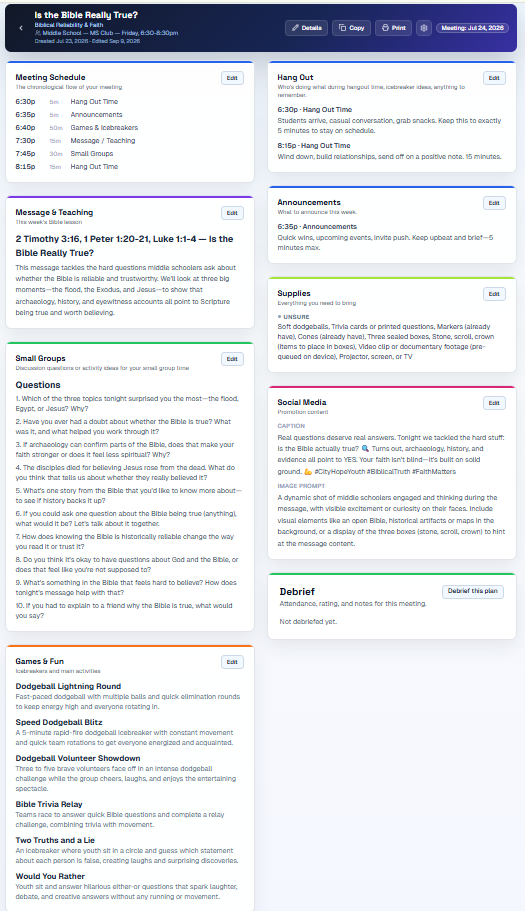
A complete Youth Ministry Planner plan showing the schedule, teaching, small groups, games, supplies, social media, and debrief
A complete plan in one view: schedule, teaching, games, discussion, supplies, and more.

THE GAME IS ONLY THE BEGINNING

Less juggling.
More time for your students.

Start with your ministry’s context and this week’s direction. Get connected teaching, activities, conversations, and practical details—without writing every piece from a blank page.

Teaching prepared around your message

Turn your Scripture, theme, and key points into teaching material shaped by your group’s age and your teaching preferences. Develop and edit it in your own voice.

Games that fit your actual room

Get activities with instructions and supplies, guided by your headcount, available space, time, and preferences. Ask for a calmer option, an upfront game, or a different fit.

Conversations that carry the message further

Generate small-group questions connected to the teaching. Include worship planning when it belongs in your night, so the pieces work toward the same purpose.

A night your leaders can follow

Bring the meeting schedule, hangout time, announcements, and supply needs into one plan. Review the practical details, then copy or print the plan for your team.

Help with the work around the meeting

Get a social-media caption and image prompt to help promote the night. Save favorite games, check game history, and record a debrief to inform future planning.

More room for shepherding

Let the Planner take on the first draft and organization. Put your attention into listening, following up, developing leaders, and caring for students.

YOU BRING THE HEART. GET HELP WITH THE PLAN.

Tonight starts with a game.
Next week starts with a plan.

Try Youth Ministry Planner with your own group’s details. See how it helps with the whole night, from the first welcome to the last conversation.

Start my 14-day free trial Google or email sign-in · No credit card required

After your trial, monthly access is $39/mo. Annual options are available.
See current plans and pricing

A few quick answers.

Are these games really free?

Yes. All ten games on this page are free to read, copy, and use with your group. You only need an account if you want to try Youth Ministry Planner.

Will these work with shy teens or new students?

Use the Low pressure filter for games that start in pairs or smaller groups. Explain the activity first, offer a pass, and never make a student share something personal.

How much does it cost?

Start with a 14-day free trial, with no credit card required. After that, monthly access is $39/mo, or choose annual access at $249/year. A $149/year founding-member option is available while founding spots remain. See current plans and availability.

How does Youth Ministry Planner work?

Youth Ministry Planner uses AI to turn your ministry’s context and this week’s direction into a plan tailored to your group. Start with your ministry profile: your beliefs, teaching style, group ages and size, available space, and preferences. Then add the week’s theme or Scripture, the points you want to cover, your schedule, available supplies, and any special requests or constraints.

The Planner brings those details together to generate the parts you include—such as teaching material, games, small-group questions, worship planning, a meeting outline, supply lists, and social-media content. Your past debriefs can also help inform what it suggests next. Review the result, edit any section, or ask the AI for changes until the plan fits your students and the night you want to lead.

Does the Planner only make games?

No. It also helps with teaching preparation, worship, small-group discussion, meeting schedules, supplies, and weekly debriefs.

What happens when I click “Try it free”?

You will go to the Planner’s sign-in screen. Use Google or create an account with your existing email address and a password. Create your ministry profile, then use your 14-day trial to explore planning with your own context. No credit card is required to start.